Adopt Sockeye the Humpback Whale - He is a survivor
Sockeye is a survivor, though physically challenged he is entering his fourth decade of life. He has been entangled and saved two times.
Sockeye has a remarkable story of resilience he embodies—a malformed jaw and an attack by killer whales.
His lower jaw is severely crooked, this injury most likely occurred when he was struck by a boat as a very young calf.
Because his baleen is malformed, water gushes out unevenly when he feeds, creating a distinctive “waterfall” that cascades from the corner of his mouth at the surface. This telltale waterfall is one of the surest ways to identify him while feeding on small fish.
His flukes tell another chapter of survival. Sockeye’s black-and-white flukes bear several sets of parallel scars—classic rake marks left by the teeth of killer whales. Further proof that he has beaten the odds not once, but multiple times.
He is a living symbol of strength, adaptation, and the will to thrive against all odds.
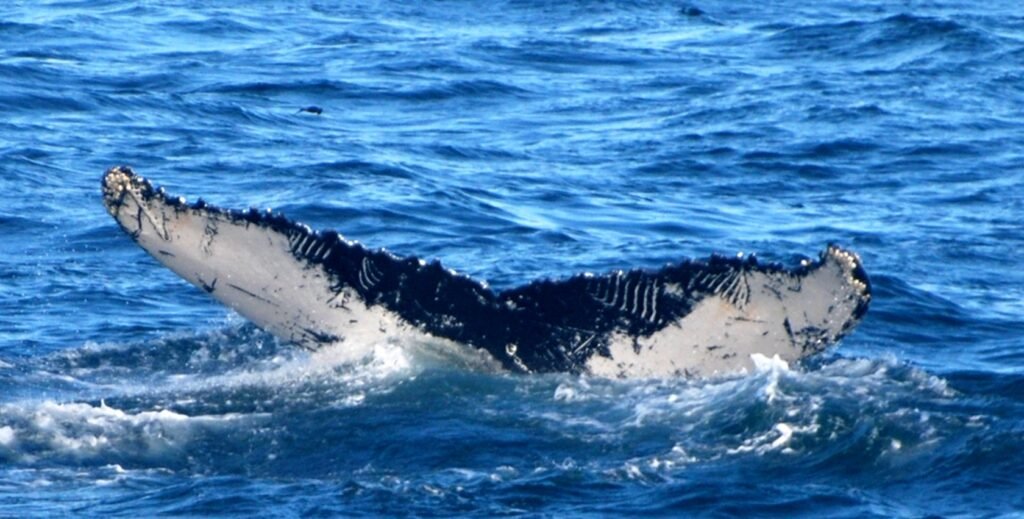
Sockeye's Fluke (Teeth Marks) © Bill Rossiter
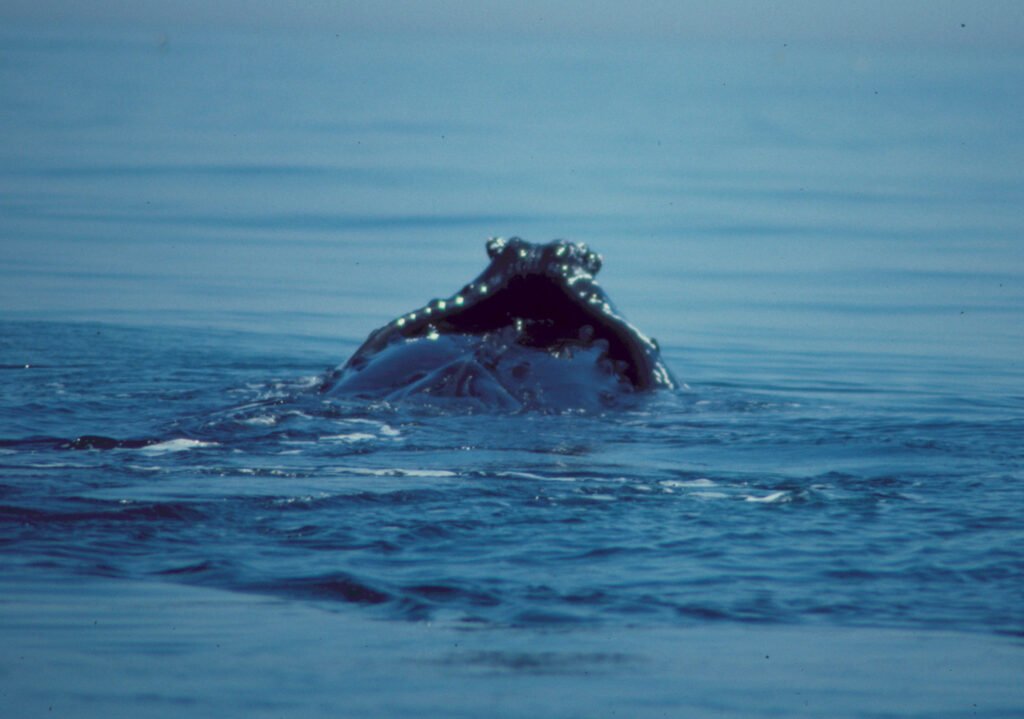
Sockeye's Jaw is Pushed In (A scene from Sockeye's adoption video)
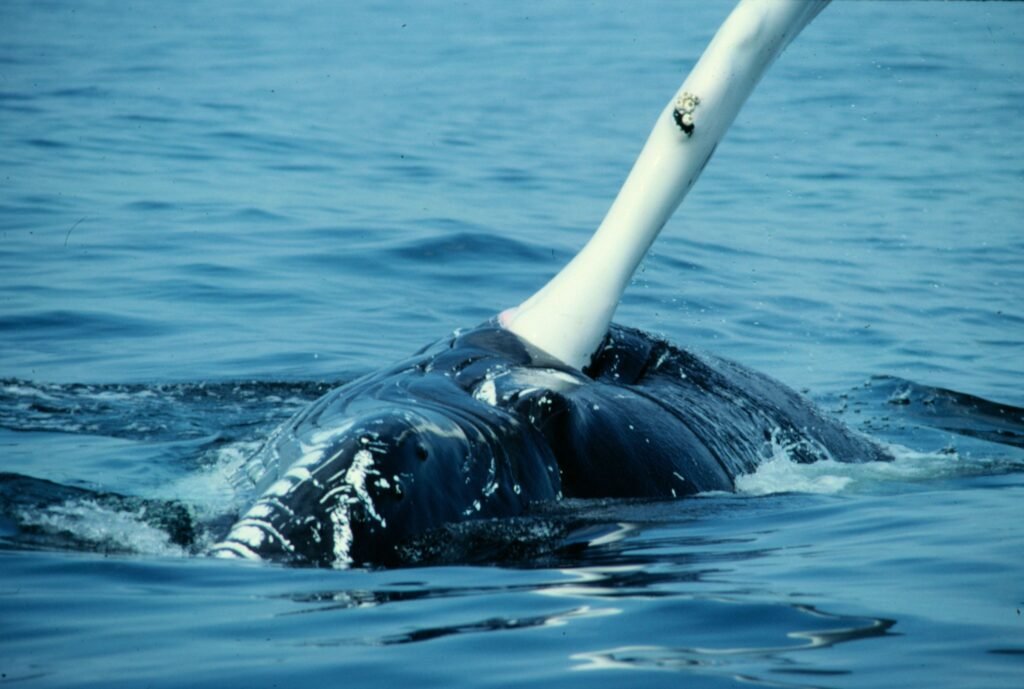
Sockeye Flipper Slapping (Eye Visible) (A scene from Sockeye's adoption video)
Sockeye Facts
Sockeye’s Story
(A Survivor)
Sockeye: The Famous Humpback Whale with the Pouty Face
Sockeye is one of the most recognizable humpback whales in the North Atlantic. First documented in 1984, he has become a beloved favorite among whale watchers and researchers thanks to his unique appearance and friendly, approachable personality.
His Most Famous Feature: The “Sockeye Pout”
Sockeye’s upper jaw is severely deformed and twisted, so it doesn’t line up with his lower jaw. This gives him a permanent pouting or frowning expression — remarkably similar to the protruding snout of a sockeye salmon, which is how he got his name.
Because of the deformity:
– His baleen plates (the comb-like structures used for filter feeding) grow outward from the top of his mouth outward instead of hanging down like in normal humpbacks.
– Despite this significant disability, Sockeye feeds successfully and appears to be in excellent health decades later — a testament to his resilience.
Other Easy Identification Marks
– Large white scar just behind his blowholes (visible from far away when he surfaces)
– Unique fluke (tail) pattern and dorsal fin shape recorded in humpback photo-ID catalogs
Thanks to his unmistakable jaw, scar, and overall charisma, Sockeye is one of the easiest humpback whales to identify at sea — even for first-time whale watchers. He remains a living example that nature sometimes makes exceptions and lets the “different” ones not only survive, but thrive.
Sockeye’s Video Documentary (34 Min)
A captivating 34-minute documentary chronicles Sockeyes life and beautifully illustrates why the title (A true Survivor) fits him so perfectly.
These ocean visits in his documentary demonstrate his ability to adapt to his limitations for feeding and although damaged by a boat in the past, how he is still curious about them even now.
The feeding scenes provide examples of the waterfall effects coming from his mouth providing a unique way of identifying a whale from its feeding techniques. No other whale can create this interesting and entertaining look at a critical yet common process, capturing fish. He even uses the side of boats to limit the movement of schools of fish desperately trying to get away from his wide open mouth.
Sockeye also approaches boats with exuberance, getting within a foot or two but never touching. One one visit, he raised his 16 foot long flipper (the longest of all species of whales) up over the heads of whale watchers standing along the boats railing. Quite a smart way of demonstrating the size of his flippers.
During another sighting, Sockeye was traveling with two other humpbacks. Suddenly one started flipper slapping. Shortly all three were doing it together. This is the only time we witnessed and captured on video three humpbacks in synchronous flipper slapping.
Throughout the film Sockeye displays the full repertoire of mature humpback behavior with effortless grace:
Deep, prolonged dives
Kick-feeding (creating bubble nets with powerful tail kicks)
Spectacular open-mouth lunge feeding at the surface
– Flipper slapping
– Lobtailing
– Curious and confident approaches to boats
– Powerful, acrobatic breaching
Two other adoption whales make appearances in this documentary, Coral and Bandit
Sockeye’s Family Tree
Sockeye was first sighted on Stellwagen Bank in 1984, when he appeared to be a young whale, roughly 3–4 years old.
When a humpback whale calf is seen with its mother and she is identified, a large part of that calf’s family tree can usually be traced through the maternal line. Paternity cannot be determined in the field, but the mother and her other calves (the calf’s siblings) can be documented.
In Sockeye’s case, however, no mother has ever been confirmed; he remains the only known whale in his matriline.
Sockeye’s Friends
Humpback whale relationships are very short term lasting a few hours or a few days.
Determining whether whales form true friendships or merely tolerate certain companions is challenging, but when multiple humpbacks approach a boat together and move in coordinated harmony, it’s reasonable to describe them as friends—or at least close associates.
Sockeye has been sighted in small group feeding with Salt, Seal, Coral, Bandit, Agassiz and Tear.
On a spectacular and rare sighting, Sockeye was traveling with two unidentified humpbacks and he started flipperslapping. One of the other whales started following his lead and finally all three were raising their flippers high in the air. Triple flipper slapping, we never saw it before this trip in 1988.
Also worth noting, in 1988 Sockeye was seen with Agassiz and suddenly Agassiz stood on his head, tail high in the air for a few seconds!