Adopt Bandit the Humpback Whale - He is complicated
While most humpback whales are identified by the unique black-and-white pigmentation patterns and scars on the underside of their tail flukes, Bandit stands out differently. He earned his name from two prominent white scars on the top of his fluke, forming a pattern that resembles a bandit’s mask.
Humpback whales commonly employ bubble-net feeding: they slap their tails on the surface to stun prey, blow rings or clouds of bubbles beneath schooling fish to corral them, then lunge upward with mouths agape to engulf the trapped fish.
Bandit, however, has his own signature variation. He forcefully slams his massive tail on the water—often 4 or 5 times in succession—before slashing it vigorously back and forth across the surface. Only then does he dive beneath the bubble cloud he’s created to feed. This dramatic, repetitive tail-slashing at the surface is unique to Bandit, allowing experienced observers to recognize him from a great distance based solely on his unmistakable feeding style.
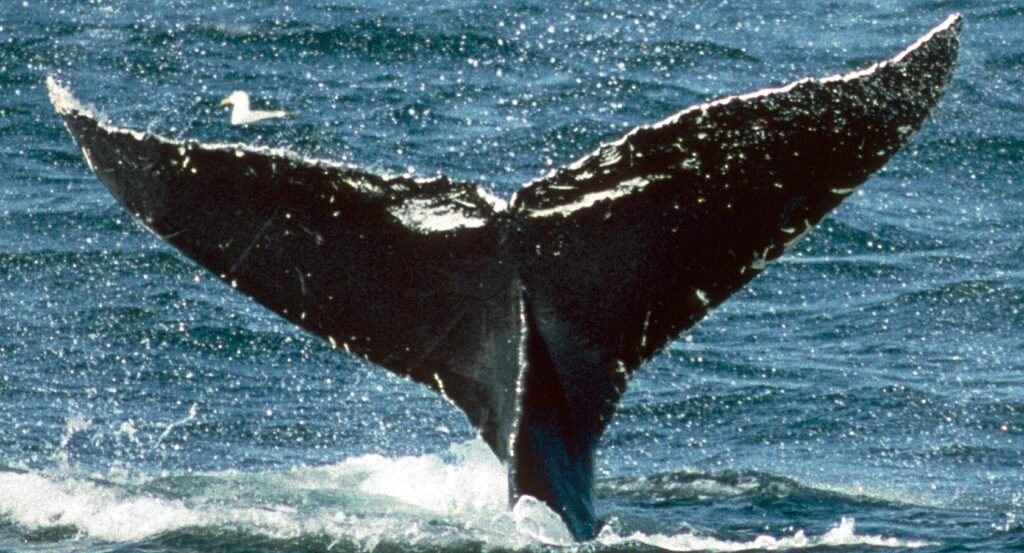
Bandit's Fluke (The mask) © Carole Carlson
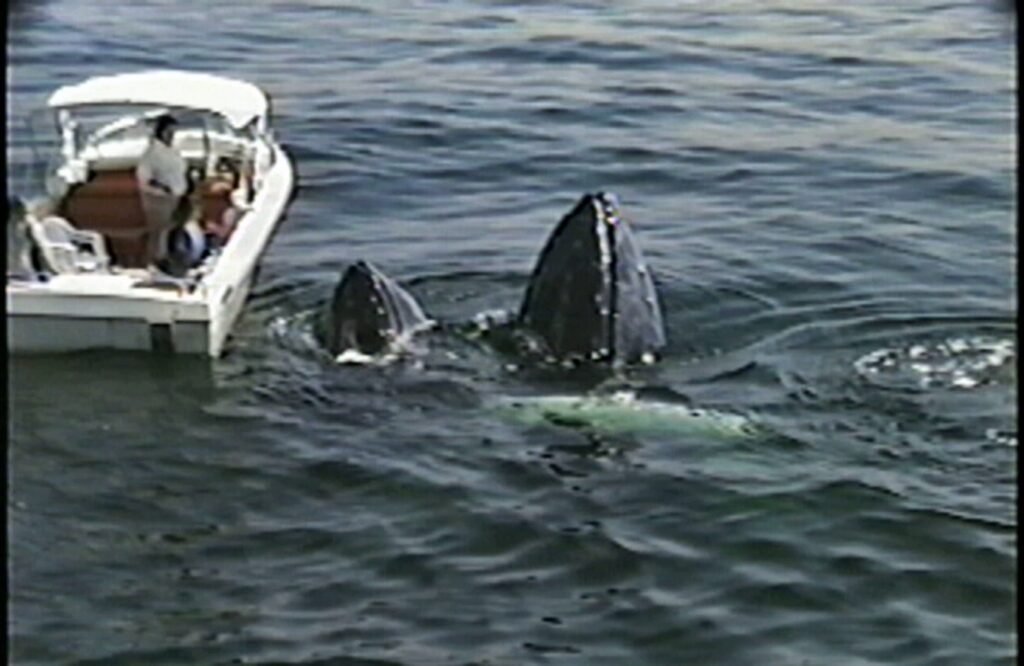
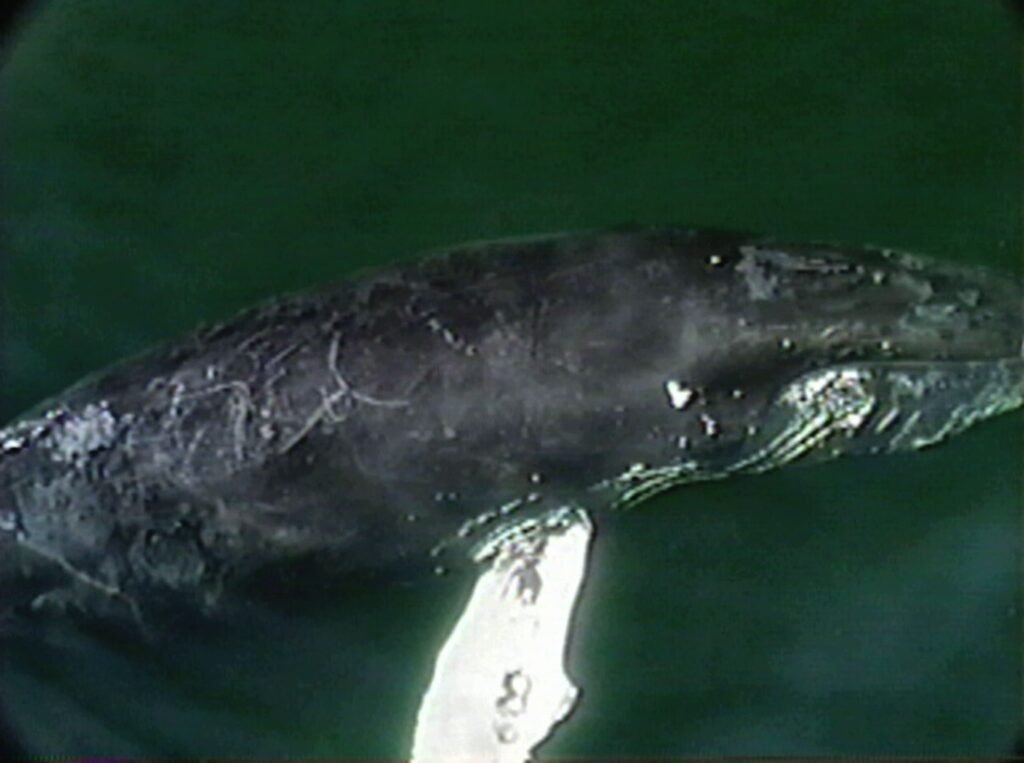
Bandit is closest to boat (A scene from Bandit's adoption video)
Bandit very close to the boat (A scene from Bandit's adoption video)
Bandit’s Story
Bandit, a beloved humpback whale, was first sighted in 1988. At the time, he appeared to be several years old, leaving his maternal lineage unknown and his full family tree somewhat mysterious.
He has a complicated feeding method unique to just him and it is very dramatic as witnessed in his documentary.
Bandit is also known for his bold, sometimes reckless interactions with vessels. He bears propeller scars near his left pectoral flipper from a past boat strike.
In one notable incident, he deliberately but gently struck a large whale-watching boat with his flipper and tail, causing no damage to the vessel and posing no danger to the passengers.
One of the most memorable sightings involved Bandit leading a group of three other humpbacks toward a small private boat, positioned about 100 feet from our vessel.
The whales spyhopped—rising vertically to peer above the surface—just feet from the family aboard, who appeared terrified. For around 15 minutes, the group circled the boat, swam underneath, and closely inspected it from every angle before moving on to approach our boat to repeat their behaviors.
Bandit’s Video Documentary (30 Min)
A thrilling 30-minute documentary offers fascinating insights into Bandit’s life, perfectly capturing why the name “complicated” fits him so well. This film stands out as one of the most exciting in our series—second only to the program featuring Colt.
Bandit is a remarkably confident humpback whale who regularly surprises passengers by approaching boats at very close range, even striking a boat accidentally on one occasion.
Scenes in the documentary show distinct propeller scars on Bandit’s side from a previous encounter with a small vessel, underscoring that the size of the boat doesn’t deter him—whether large or small, he gives them all the same curious treatment.
In one example featured, a family aboard a small boat appears genuinely alarmed by how close he comes. Bandit exhibits a variety of behaviors, including several types of blows that range from typical to highly energetic, sometimes described as trumpeting.
He is a master of close approaches and is often seen in the company of other males—who seem to feed off his energy—during their interactions with boats. Whether this is play or competition isn’t entirely clear, but to onlookers it often seems like both.
Among the males he brings near boats are Colt, Coral, Sockeye, and Thread; he has also been sighted with Salt, one of the most beloved whales in the community.
Throughout the program, Bandit displays the full repertoire of mature humpback whale behaviors with remarkable grace:
- Deep, prolonged dives
- Bubble-net feeding using powerful tail kicks
- Spectacular open-mouth lunge feeding at the surface
- Flipper slapping
- Lobtailing (tail slapping)
- Curious, confident approaches to boats
- Powerful, acrobatic breaching
These behaviors not only highlight the complexity of Bandit’s character but also illustrate the dynamic and energetic life of humpback whales in their natural environment.
Bandit’s Family Tree
Bandit was first sighted on Stellwagen Bank in 1988, when he appeared to be a young whale, estimated to be 2–3 years old.
When a humpback whale calf is seen with its mother and she is identified, a large part of that calf’s family tree can usually be traced through the maternal line. Paternity cannot be determined in the field, but the mother and her other calves (the calf’s siblings) can be documented.
In Bandits case, however, no mother has ever been confirmed; he remains the only known whale in his matriline.
Bandit’s Friends
Humpback whale relationships are very short term lasting a few hours or a few days.
Determining whether whales form true friendships or merely tolerate certain companions is challenging, but when multiple humpbacks approach a boat together and move in coordinated harmony, it’s reasonable to describe them as friends—or at least close associates.
Bandit has been seen on multiple days with the males Colt, Coral, Sockeye, and Thread; he has also been sighted with Salt, one of the most beloved female whales in the community.